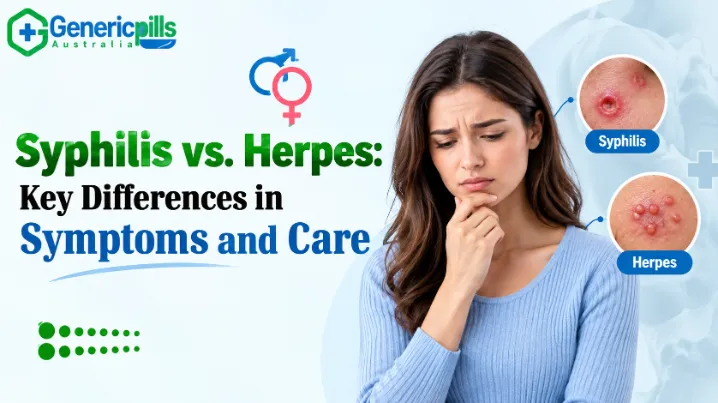
Syphilis vs. Herpes: Key Differences in Symptoms and Care
- Chikenpox
 Written by Same Luise
- Medically reviewed by Dr. Roman Kennedy
1. Introduction
Worry can follow a person when a new sore, blister, rash, or some unusual skin condition suddenly appears. Because when that happens, over the mouth or genitals, one may wonder whether they have an STI [sexually transmitted infection] or what.
Such lesions on the skin can be because of two of the most common yet dreadful infections, which are syphilis and herpes. Both of these infections can easily affect genital areas and the mouth, and it’s important to know that both such infections can be caused by very different germs, which may require completely different treatment.
So, first, let’s understand the difference between Syphilis vs. Herpes, and all the relatable queries that people have in mind related to them, such as;
- How do the symptoms compare?
- What is a syphilis test?
- And where do genital HSV, cold sores, and shingles fit into the picture?
Let’s move forward and break it down in simple terms
Important: A sore or rash doesn’t directly mean that you must have an infection, but if you have some genital sores, a rash over there, blisters, or any possible STI exposure, then you should reach out to a healthcare professional and consider testing.
But many times one may stay confused between these two infections, so let’s understand the difference.
2. Syphilis vs. Herpes: What Is the Difference?
The easiest way to understand Syphilis vs. Herpes is to first read the causes, because of which they can be caused.
Syphilis is a bacterial infection that can be caused by a bacterium named Treponema pallidum, and its effects can affect various parts of the body. In some cases, when it’s left untreated, it can cause various health troubles, and as per the Australian Government, syphilis may not have perceptible symptoms.
Herpes, on the other hand, is a viral infection caused by HSV, also known as herpes simplex virus. Mainly, it is of 2 types, HSV-1 and HSV-2. HSV-1 is linked to oral herpes, while HSV-2 is a major cause of genital herpes. But please let us mention that both types can infect the human genital area.
Here’s a quick comparison:
| Feature | Syphilis | Herpes |
| Cause | Treponema pallidum bacterium | Herpes simplex virus |
| Type | Bacterial STI | Viral infection |
| Common early lesion | Often a painless sore | Often painful blisters or ulcers |
| Testing | Blood tests and clinical assessment | Clinical assessment and, when appropriate, lesion testing |
| Treatment | Antibiotics | Antiviral medicines |
| Cure | Can be cured with appropriate treatment | Can be managed, but the virus remains in the body |
The important point is that syphilis and herpes are not the same infection. A treatment that works for one does not automatically work for the other.
3. Understanding Syphilis
➜ What Is Syphilis?
Syphilis is quite a well-known infectious disease that is transmitted sexually, hence considered an STI, and as mentioned above, it is caused by the bacterium Treponema pallidum.
Through sexual contact, it can spread, and it can also be passed down by a pregnant woman to their unborn child. The tricky thing about it is that one can miss its symptoms quite easily, and in some cases, people may not experience any symptoms at all.
➜ Stages of Syphilis
Syphilis can develop through different stages.
In primary syphilis, a patient is more likely to experience a sore called a chancre at the site of infection on their body. That sore is most of the time painless, so one may avoid it quite easily. The location of that sore can be;
- The genitals,
- Anus,
- Mouth, or
- Other areas involved in contact.
Whereas, in secondary syphilis, the patient may experience symptoms such as;
- Rash,
- Swollen lymph nodes,
- Fatigue,
- Headache,
- Sore throat, and
- Other skin or mucous-membrane changes.
There’s another possible condition of this infection, which experts call latent syphilis; it comes with no visible symptoms at all, and this infection can still be there even when the person feels well. Without proper treatment, this medical condition can seamlessly grow and keep causing serious health problems.
➜ Common Syphilis Symptoms
Possible symptoms include:
- A painless sore or ulcer
- Rash
- Swollen lymph nodes
- Headache
- Fatigue
- Sore throat
- Hair loss
- Other skin or mucous-membrane changes
There can be a condition where a patient may not have any symptoms, but the infection can still be there; therefore, regular STI testing matters.
➜ What Is a Syphilis Test?
Through a syphilis test, doctors can find out if a person is infected with Treponema pallidum or not. Here, blood tests are common, and depending on that person’s medical condition, the doctor may prescribe one of more types of tests to ensure a proper diagnosis.
The Australian Government recommends such STI testing because of the fact, that various such infections are symptomless and reside in the human body for a long time.
4. Understanding Herpes Simplex Virus
What Is Herpes Simplex Virus?
The herpes simplex virus is the causative factor that causes herpes in human beings; because of this infection, humans may have painful blisters or ulcers.
There are two main types:
- HSV-1
- HSV-2
Most of the people infected with herpes may not have any symptoms at all or may have some, which means that a person may carry this virus without even realising it.
5. What Is Genital HSV?
As the name suggests, Genital HSV is a herpes simplex infection in which the virus affects the genital area of a human being. It can cause:
- Small blisters
- Painful ulcers
- Burning
- Tingling
- Itching
- Pain when urinating
- Tender lymph nodes
- Flu-like symptoms during some first episodes
However, there can be symptoms, and at some point in time, there may not be; a few people may experience repeated outbreaks, while others may not even notice any symptoms.
➜ Genital Herpes Infection
A genital herpes infection can be caused in humans by either HSV-1 or HSV-2; however, the latter is much more likely to cause such repeated genital outbreaks, and the prior tends to recur less often.
➜ Cold Sore Herpes
Cold sore herpes, or should we call it oral herpes, i is usually caused by HSV-1. These cold sores often suddenly appear as small blisters or open sores around the lips or mouth. They may begin with tingling, itching, or burning before the visible sore develops.
➜ Mouth Herpes
Mouth herpes can affect the lips, mouth, or nearby skin.
It is worth remembering that not every mouth ulcer is herpes. Canker sores, irritation, injuries, and several other conditions can look different from herpes.
If you are unsure, a healthcare professional can help.
7. Syphilis vs. Herpes Symptoms: How Can You Tell Them Apart?
This is where things can get confusing.
➜ Syphilis Symptoms
An early syphilis sore is often:
- Painless
- At the site of infection
- Round or ulcer-like
- Temporary, meaning it may disappear even without treatment
Later, syphilis may cause a rash and other symptoms.
The problem is that syphilis does not always follow a textbook pattern. The Australian Government notes that clinical presentation can vary considerably and that syphilis can be asymptomatic.
➜ Herpes Symptoms
Herpes more commonly causes:
- Painful blisters
- Painful ulcers
- Tingling
- Burning
- Itching
- Recurrent outbreaks
The first episode can sometimes also cause fever, body aches, headache, or swollen lymph nodes.
➜ Can You Tell Them Apart by Looking?
Not reliably.
A painful blister may suggest herpes, while a painless ulcer may suggest syphilis. But there are exceptions.
That’s why trying to diagnose an STI from a photo or by comparing your symptoms with pictures online can lead you in the wrong direction.
Testing and professional assessment are much more reliable.
8. Herpes vs. Zoster: Are They the Same?
People get confused between them because once they hear.
Here’s another common source of confusion. word herpes, they tend to think it’s the same as zoster and shingles. But these words are not interchangeable, as both herpes simplex and herpes zoster are caused by different viruses.
➜ What Is Zoster?
Zoster, also known as herpes zoster or zoster shingles, is caused by the varicella-zoster virus (VZV), and yes, it’s the same virus that can cause chickenpox. Once someone has chickenpox, the virus itself may remain dormant in the human body and may activate a couple of years later and cause shingles.
So, while the word “herpes” appears in “herpes zoster,” shingles is not the same thing as HSV-1 or HSV-2
➜ Chickenpox and Shingles
Chickenpox — more commonly spelled chickenpox — is the initial infection caused by varicella-zoster virus.
Later in life, the same virus can reactivate and cause shingles.
This is why someone who has had chickenpox can develop zoster years later.
➜ What Does Facial Shingles Look Like?
Facial shingles can cause pain, tingling, and a blistering rash on one side of the face.
Shingles can sometimes affect the area around the eye. This can lead to serious complications, including vision problems, so a rash or pain around the eye should be assessed promptly.
9. HSV vs. Zoster
A simple way to remember it:
- HSV-1/HSV-2 → herpes simplex
- Varicella-zoster virus → chickenpox and shingles
They are related only in the broad sense that both belong to the herpesvirus family. They are not the same infection.
10. How Are Syphilis and Herpes Diagnosed?
➜ Syphilis Diagnosis
A healthcare professional may consider your symptoms, sexual history, examination findings, and laboratory results.
A syphilis test commonly involves blood testing. Different types of blood tests can be used, and interpreting them together can be important.
➜ Herpes Diagnosis
If there is an active blister or ulcer, a healthcare professional may be able to collect a sample from the lesion for testing.
Australian STI guidelines recommend appropriate testing when confirmation is needed and caution against routine HSV blood screening in people without symptoms.
➜ When Should You Get Tested?
Consider speaking with a healthcare professional if:
- You develop a new genital sore
- You notice unexplained blisters
- You have a new rash
- A sexual partner has an STI
- You have had unprotected sexual contact
- You are pregnant and may have been exposed to an STI
- You have recurring unexplained genital symptoms
The Australian Government points out that many STIs cause no symptoms, so testing can be important even when you feel completely well.
➜ Syphilis vs. Herpes Treatment
The treatment difference is one of the most important things to understand.
➜ How Is Syphilis Treated?
Syphilis is a bacterial infection, so it requires antibiotic treatment.
The specific treatment depends on the stage and clinical situation. The Australian Government states that syphilis is treatable with antibiotics and recommends discussing the appropriate treatment with a healthcare professional.
➜ How Is Herpes Treated?
Herpes is caused by a virus, so treatment is different.
Antiviral medicines can reduce the severity and duration of symptoms. They can also be used in some people to reduce recurrent outbreaks.
One commonly used antiviral is aciclovir, also known as acyclovir.
Australian STI guidelines list aciclovir among treatment options for genital herpes.
An Important Difference
➜ Acyclovir does not treat syphilis.
This is worth remembering because someone who sees a genital sore may assume an antiviral medicine will cover every possible infection. It will not.
The right treatment depends on the actual diagnosis.
➜ Acyclovir and Herpes Treatment
Acyclovir is an antiviral medicine used against certain herpesvirus infections.
Australian medicine information lists acyclovir for conditions including genital herpes and herpes zoster, depending on the product and clinical situation.
You may come across different strengths and brand names online, including:
- Ocuvir DT 200mg
- Acyclovir 800mg
- Zoviclovir 800mg
- Acivir 400mg DT Tablet
- Ocuvir 400mg
- Zoviclovir 200mg
- Acyclovir 400mg
- Acyclovir 200mg
These names are for completely different medications, though how similar they sound similar, and must not be used as interchangeable medications by oneself. Only a doctor can choose and prescribe the strength of the medication and formulation once they have checked their patient’s overall health, including kidney function, age, and various other factors.
For example, the TGA’s Australian Register of Therapeutic Goods has listed acyclovir medicines in 200mg, 400mg, and 800mg strengths.
So, if you see Acyclovir 200mg, Acyclovir 400mg, or Acyclovir 800mg, please don’t assume those numbers by themselves, because the correct strength can only be prescribed in your doctor’s treatment plan.
If you’re looking at generic options, resources such as Generic Pills Australia can get it with a prescription, but please reach out to your doctor first.
11. How Can You Prevent Syphilis and Herpes?
To be very honest, there is no single step that you can take that will keep you risk-free from every STI. However, you can implement a combination of safer-sex practices and frequent testing that can help you stay safe.
➜ Preventing Syphilis
The Australian Government recommends:
- Using condoms during vaginal and anal sex
- Using dental dams during oral sex
- Getting regular STI tests
- Avoiding sexual contact when symptoms are present
- Ensuring sexual partners are tested and treated when appropriate
- Preventing Herpes
Herpes can spread even when there are no visible sores.
To reduce the risk:
- Avoid sexual contact during an outbreak
- Use condoms
- Talk openly with sexual partners
- Avoid direct contact with active cold sores
- You must follow all the given medical advice if you’re having genital herpes frequently.
The use of condoms can simply reduce the risk of Herpes and its transmission, so please use them. And please remember that in some cases, where the part of the skin is not covered by condom, can transmit infection through skin-to-skin contact.
12. When Should You See a Doctor?
It is a good idea to get medical advice if you notice something new or unusual.
This is especially important if you have:
- A new genital sore
- Painful genital blisters
- A painless genital ulcer
- An unexplained rash
- Burning or tingling around a new lesion
- A new sexual partner and possible STI exposure
- A partner who has been diagnosed with an STI
- Repeated genital or mouth sores
- Facial shingles
- Pain or a rash close to the eye
One mustn’t wait for the arrival of symptoms or for them to get worse to get tested; they should go right away. And please don’t forget that some of the STIs may not have any symptoms at all, so feeling fine may not mean that you’re infection-free.
13. Syphilis vs. Herpes: Key Takeaway
Just so you don’t forget the key points of this blog, let us offer the key takeaways for Syphilis vs. Herpes in a very simple and to-the-point version;
- A bacterium is the causative factor for Syphilis
- Herpes simplex virus causes herpes.
- Syphilis can be symptomless, with some painless sore.
- Herpes commonly causes painful blisters or ulcers.
- A syphilis test is important because symptoms can be mild or absent.
- Genital HSV can be caused by HSV-1 or HSV-2.
- Cold sore herpes usually refers to oral HSV.
- Zoster, or shingles, is caused by varicella-zoster virus, not HSV.
- Chickenpox and shingles are completely different infections that can be caused by the same virus at different stages.
- Acyclovir is very useful in treating various herpesvirus infections.
- Acyclovir does not treat syphilis.
- If you’re having a new genital sore, rash, or possible STI exposure, then you must consider testing and medical advice as the safest next steps.
- Testing and medical advice are the safest next steps.
14. Frequently Asked Questions (FAQs)
Important:The medical information in this article was checked against government and other authoritative health sources